Language

In the construction of a tire inner tube factory, the selection of heating methods (electric heating/steam heating) for vulcanizer hot plates is a key link affecting the production process, operating costs, and product-related characteristics. It should be clarified that there is currently no authoritative scientific research or certification conclusion to clearly determine which of the two is better, nor is there any investigation report proving that the inner tubes produced by electric heating vulcanizers have higher quality. The following will conduct a detailed comparison of the two heating methods from core dimensions such as process characteristics, temperature distribution, infrastructure requirements, environmental protection and convenience, and energy efficiency.
I. Comparison of Core Dimensions
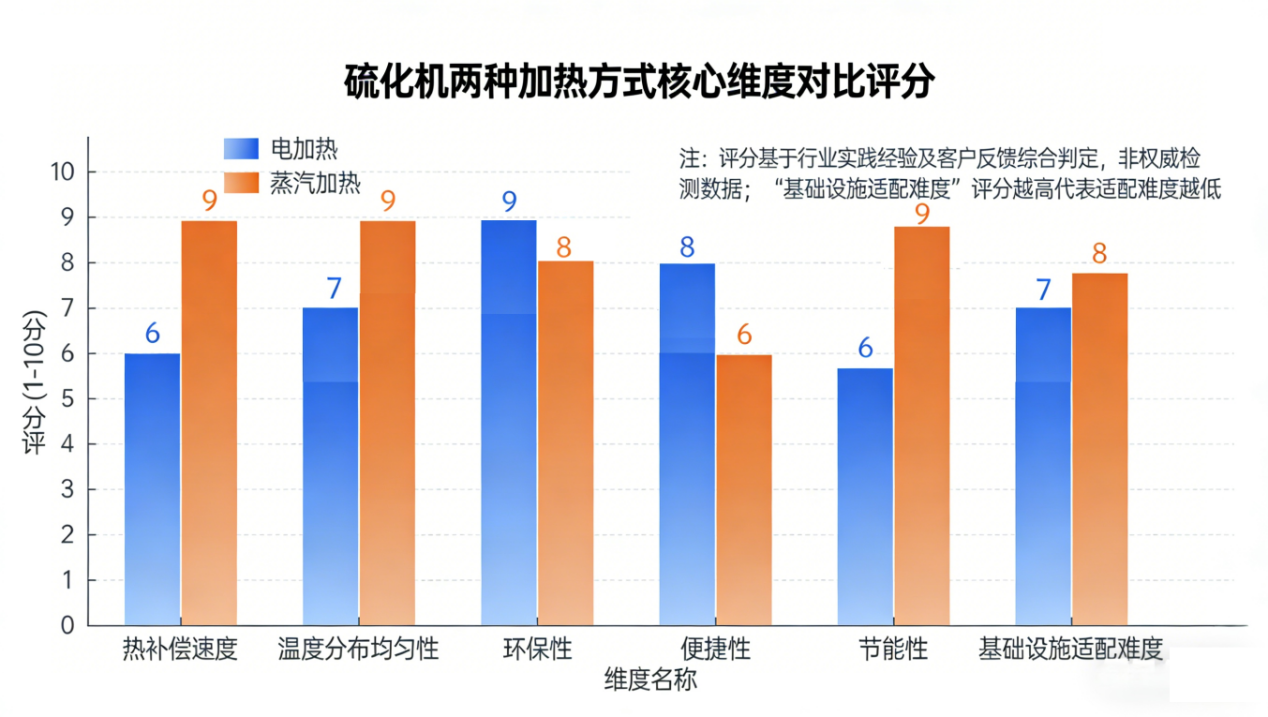
Note: The scores in the chart are comprehensively determined based on industry practice experience and customer feedback, not authoritative test data; the higher the score of "Difficulty of Infrastructure Adaptation", the lower the adaptation difficulty.
1. Process Characteristics: Differences in Heat Compensation Mechanisms
The response speed of heat compensation is one of the core process differences between the two heating methods.
The electric heating method needs to monitor temperature changes in real time through sensors, and only starts the heat compensation program when the temperature is detected to be lower than the set threshold. This process relies on the signal transmission of the sensor and the command response of the control system, with a certain delay.
The steam heating method does not require sensors to detect temperature, and realizes independent heat compensation relying on the thermodynamic characteristics of steam itself. When the temperature of the hot plate drops, high-temperature steam will quickly supplement heat, so the heat compensation response speed is better, and the stability of the hot plate temperature can be maintained more quickly.
2. Temperature Distribution: Empirical Comparison Conclusion
Regarding the uniformity of temperature distribution, there is currently no accurate authoritative verification data support. However, according to the practical experience feedback collected from process managers of many tire factories, the temperature distribution uniformity of steam-heated hot plates is generally better than that of electric heating. This conclusion comes from the intuitive feeling in front-line production practice. Although it has not been systematically scientifically verified, it has high reference value.
3. Infrastructure Requirements: Significant Differences in Supporting Conditions
The two heating methods have significantly different requirements for the supporting facilities of the factory infrastructure, which directly affect the planning and investment in the initial stage of factory construction:
•Electric heating vulcanizer: The core requirement is the stability and carrying capacity of the factory's power supply system. It is necessary to calculate the total power consumption of the equipment in advance to ensure that the power grid can supply power continuously and stably, avoiding the impact on production due to voltage fluctuations or power outages; there is no need to add additional large-scale supporting equipment, and the infrastructure planning is relatively simple.
•Steam heating vulcanizer: It is necessary to construct supporting boiler equipment and steam transmission pipeline systems. The selection and installation of boilers must comply with relevant national safety standards. The laying of steam pipelines must consider heat loss and safety protection. The complexity, investment cost and approval process of infrastructure construction are all higher than those of the electric heating method.
4. Environmental Protection, Convenience and Energy Efficiency: Comparison of Core Advantages
Excluding the differences in infrastructure construction, the core advantages of the two heating methods are obviously differentiated:
•Advantages of electric heating: More environmentally friendly and convenient. The electric heating process has no exhaust gas or waste residue emissions, which meets the requirements of green production; the equipment start-up, commissioning and daily operation and maintenance processes are simple, and there is no need for a professional boiler operation and maintenance team, which can effectively reduce operation and maintenance costs and management difficulty.
•Advantages of steam heating: More energy-efficient. Steam heating relies on boiler heating, with high heat utilization efficiency. Especially in large-scale production scenarios, the energy consumption cost per product is lower than that of the electric heating method, and the energy-saving benefit of long-term operation is more significant.
II. Summary
There is no absolute advantage or disadvantage between the electric heating and steam heating methods for vulcanizer hot plates. The core differences are reflected in the process response speed, infrastructure requirements and operational characteristics. If the factory focuses on environmental protection and convenience, has limited infrastructure investment and stable power supply, the electric heating method is more suitable; if the factory pursues heat compensation speed, temperature distribution uniformity and long-term energy-saving benefits, and has the conditions and capabilities for boiler construction, the steam heating method is more appropriate. It is recommended to comprehensively determine the optimal heating method based on the factory's actual construction plan, production scale and operational needs.